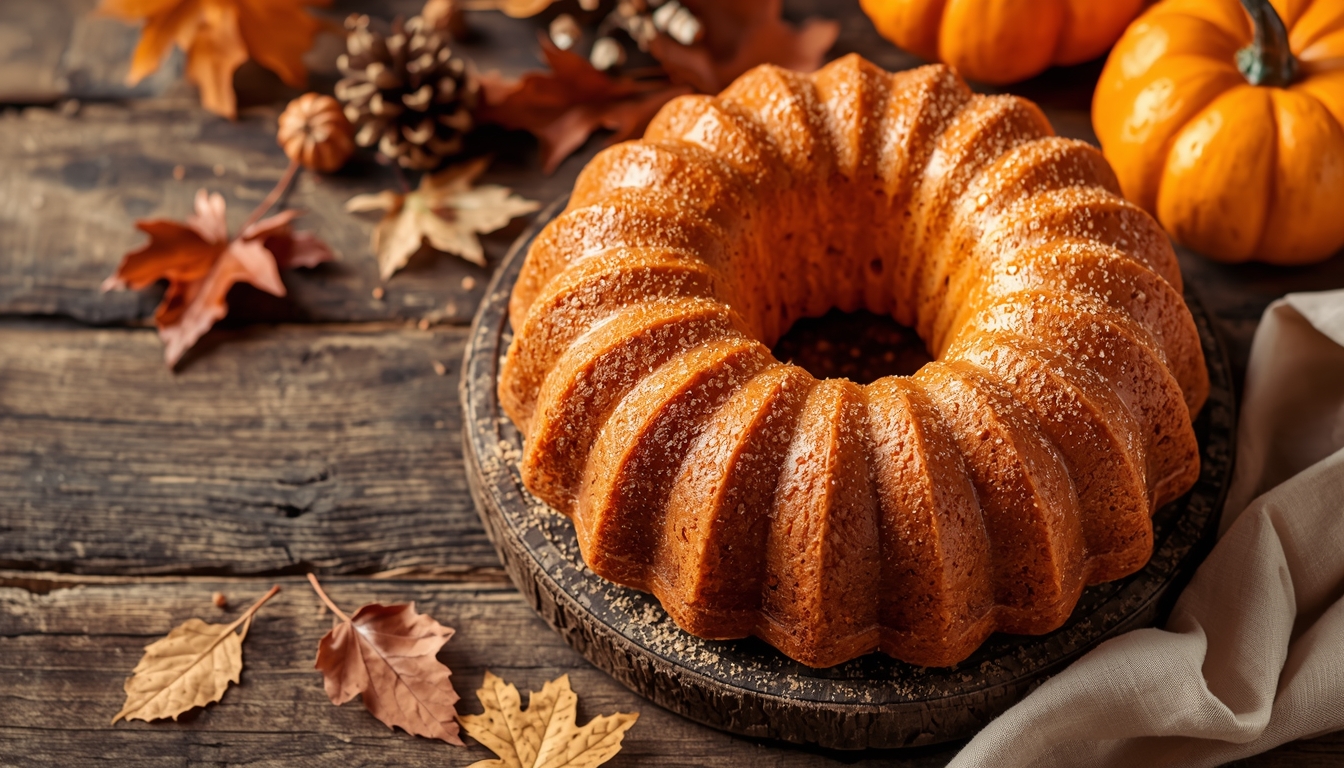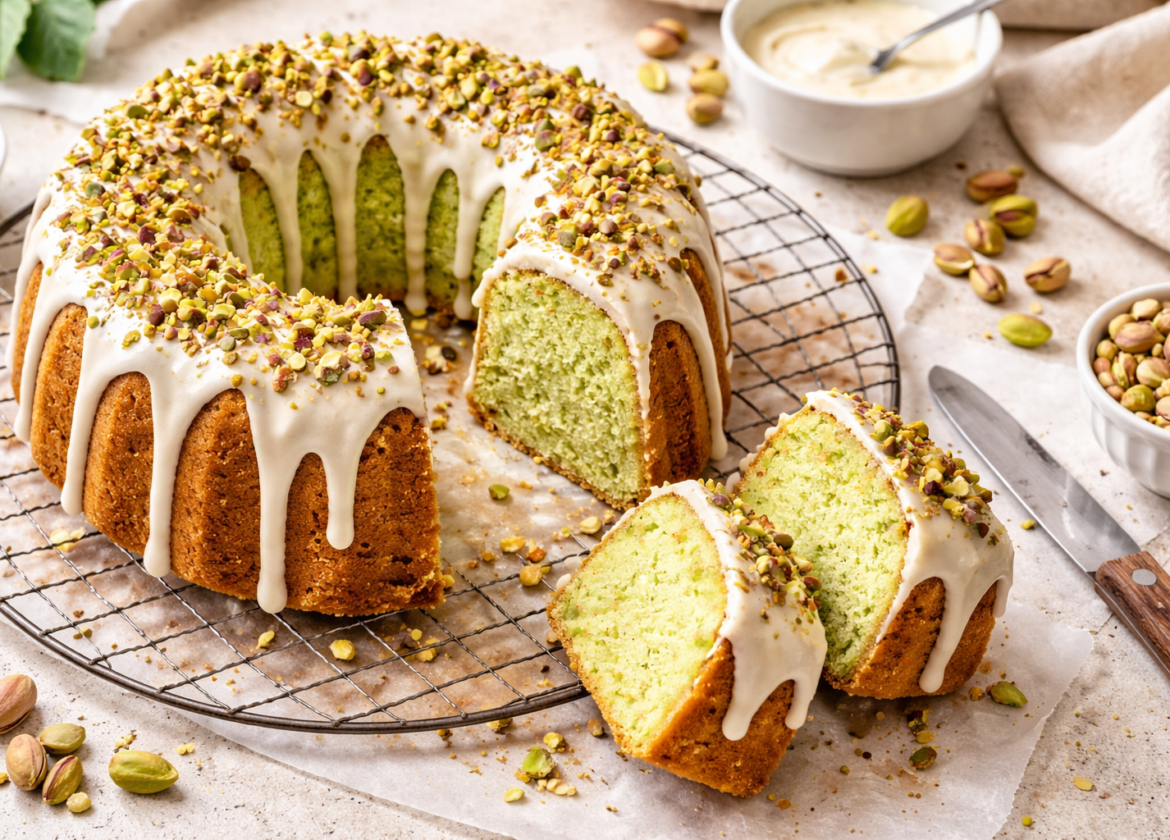
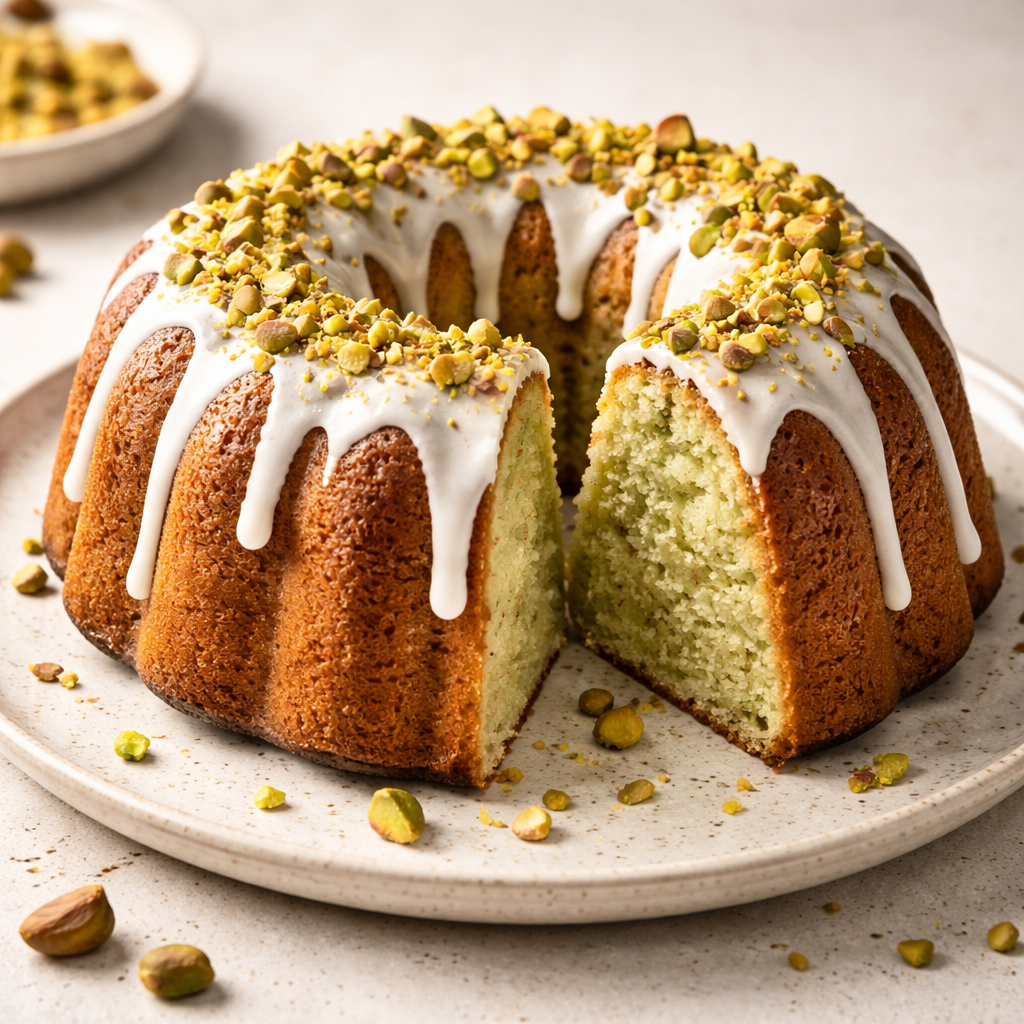
Achieving a professional-grade outcome with a Pistachio Bundt Cake Recipe requires a disciplined approach to moisture management and aeration. A Bundt cake, by its very nature, is a dense, high-volume dessert that relies on the central chimney of the pan to distribute heat evenly. When you introduce pistachios—a nut high in natural oils and fiber—the chemistry of the batter changes. Consistency in this recipe is not a matter of luck; it is the result of controlling the interaction between the fats in the nuts and the structural proteins in the flour.
The hallmark of a high-quality Pistachio Bundt Cake Recipe is a fine, uniform crumb and a moist, buttery mouthfeel. Unlike lighter sponges, this cake must be sturdy enough to hold its intricate shape when inverted, yet soft enough to melt on the palate. By following a standardized technical process, home bakers can eliminate the “sinking” or “sticking” issues that often plague high-moisture nut cakes. This guide focuses on the mechanical and thermal principles necessary to produce a reliable result every time you bake.
Variables That Affect Cooking Accuracy
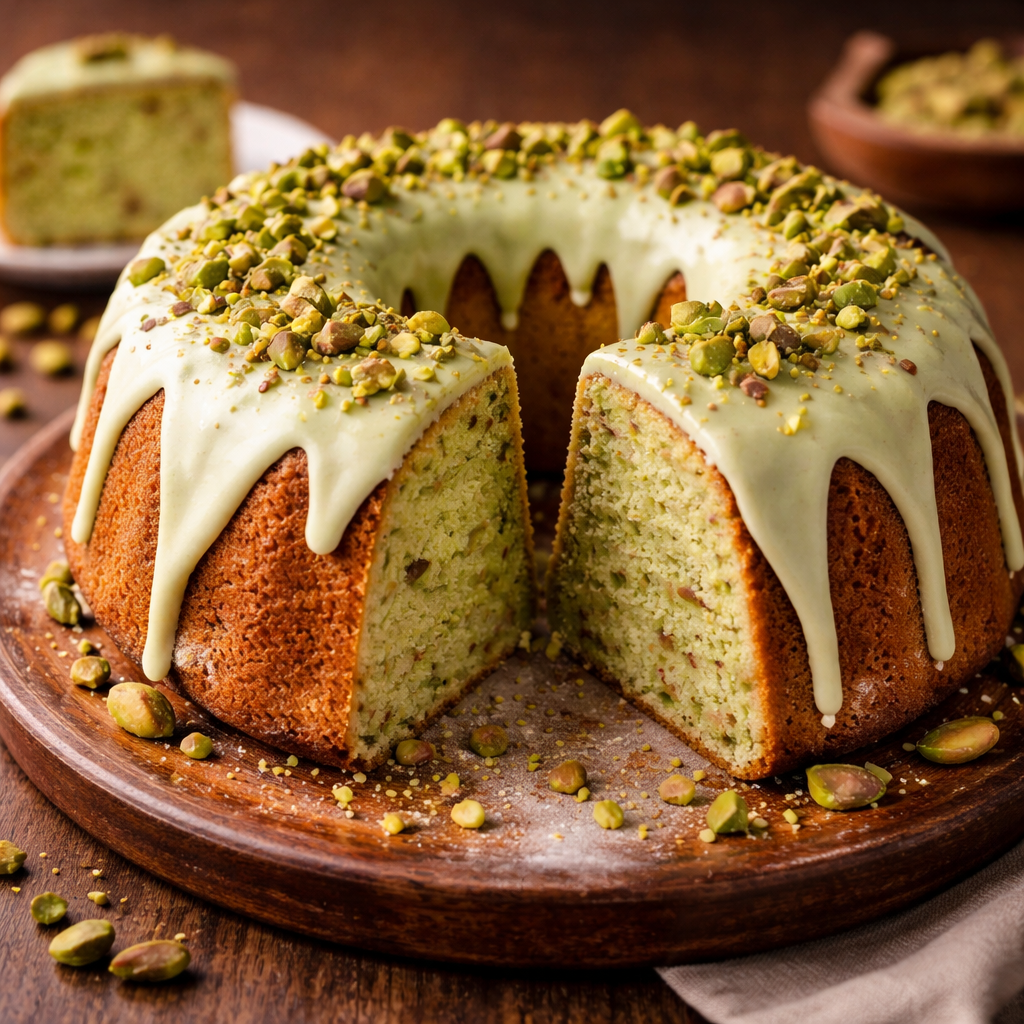
In the execution of a Pistachio Bundt Cake Recipe, several external and internal factors can alter the final texture. Identifying these variables allows the baker to make necessary adjustments before the pan enters the oven.
- Nut Grind Size: The texture of the pistachios directly impacts the cake’s “loft.” Coarsely chopped nuts can settle at the bottom, while a fine pistachio flour integrates into the crumb, providing color and uniform flavor.
- Ambient Humidity: Flour is hygroscopic, meaning it absorbs moisture from the air. On humid days, you may find the batter thinner than usual, which can affect the rise.
- Oven Calibration: Most domestic ovens fluctuate by as much as $15^{\circ}C$ ($25^{\circ}F$). A cake as dense as a Pistachio Bundt Cake Recipe requires a steady, accurate temperature to ensure the middle cooks without the exterior scorching.
- Egg Temperature: Cold eggs can cause the butter emulsion to break, leading to a “curdled” batter. This results in a finished cake with a greasy texture and uneven holes.
Ingredient Prep for Reliable Outcomes
Precision starts with the preparation of your raw materials. For a Pistachio Bundt Cake Recipe, the state of your ingredients is just as important as the measurements.
The Pistachios
Select raw, unsalted, shelled pistachios. If you use roasted or salted nuts, the salt balance and the fat stability of the cake will be compromised. To maximize flavor, lightly toast the pistachios at $150^{\circ}C$ ($300^{\circ}F$) for 5 minutes before grinding. This releases the essential oils. Once cooled, pulse them in a food processor until they resemble a coarse sand—avoid over-processing into a paste.
The Fat and Sugar
Use high-quality unsalted butter with at least 80% milkfat. Ensure the butter is softened to a pliable $18^{\circ}C$ to $20^{\circ}C$ (approx. $65^{\circ}F$). At this temperature, the butter can trap air bubbles during the creaming process, which is the primary leavening agent for a Pistachio Bundt Cake Recipe.
The Flour and Leavening
Standard all-purpose flour provides the necessary gluten structure. However, it must be sifted with the baking powder and salt to ensure even distribution. Clumps of baking powder can create large gas pockets that cause the cake to collapse during cooling.
Equipment Calibration and Setup
The physical tools utilized in a Pistachio Bundt Cake Recipe act as the primary heat conductors.
- Heavy-Duty Cast Aluminum Bundt Pan: Thin, dark-colored pans absorb heat too quickly, leading to over-browned edges. A thick, light-colored aluminum pan provides the most even thermal transfer.
- Stand Mixer: A paddle attachment is essential for the creaming phase. It incorporates air without overworking the gluten once the flour is added.
- Independent Oven Thermometer: Do not rely on the oven’s digital display. Place a thermometer on the center rack to verify the true temperature before baking.
- Digital Scale: Measuring ingredients by weight (grams) rather than volume (cups) is the only way to ensure the Pistachio Bundt Cake Recipe remains consistent across different climates and flour brands.
Timing Strategy for Best Results
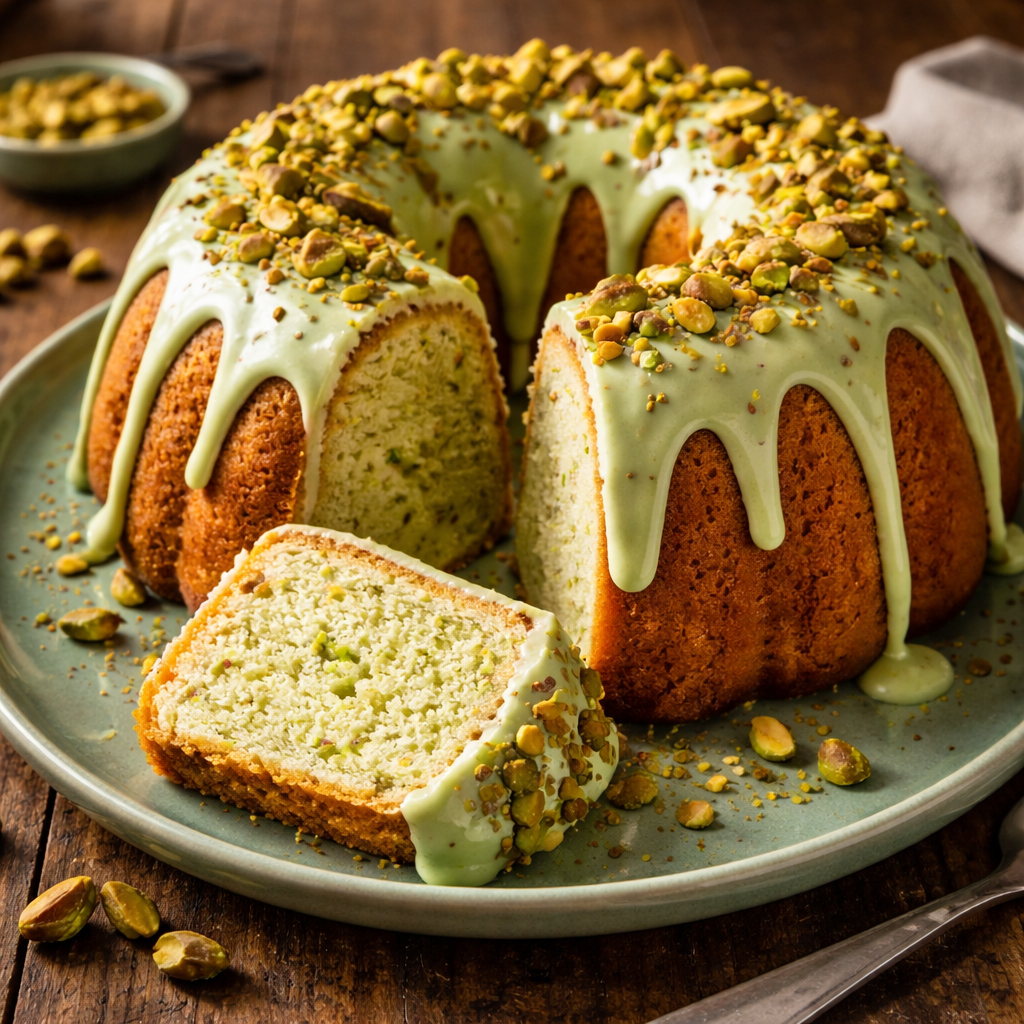
Timing in a Pistachio Bundt Cake Recipe is divided into three critical windows: the creaming phase, the baking window, and the release window.
- Creaming (5 Minutes): The butter and sugar must be beaten until the mixture is pale and voluminous. Cutting this short results in a heavy, dense cake.
- Bake Time (50–60 Minutes): Because of the depth of the Bundt pan, the cake requires a slow bake. Check the cake at the 45-minute mark, but do not open the oven door frequently, as this causes temperature drops.
- The 10-Minute Rest: After removing the cake from the oven, it must rest in the pan for exactly 10 minutes. During this time, the cake’s structure firms up, and the steam helps release the exterior from the pan’s design.
Reliable Pistachio Bundt Cake Recipe Method
1. Preparation and Coating
Preheat the oven to $175^{\circ}C$ ($350^{\circ}F$). Generously grease the Bundt pan. Tip: Use a paste made of equal parts melted butter and flour (often called “cake goop”) to coat the pan. This ensures a clean release from intricate designs.
2. Processing the Pistachios
Pulse 1 cup of pistachios with 2 tablespoons of the measured flour. The flour prevents the nuts from turning into butter. Set aside.
3. The Creaming Process
In your stand mixer, beat 1 cup (2 sticks) of butter and 1.5 cups of granulated sugar on medium-high speed for 5 minutes. Add 3 large, room-temperature eggs one at a time, ensuring each is fully incorporated before adding the next. Add 1 teaspoon each of vanilla and almond extract.
4. Alternating Addition
Sift 2.5 cups of flour, 2 teaspoons of baking powder, and 1/2 teaspoon of salt. With the mixer on low, add one-third of the dry ingredients, followed by 1/2 cup of room-temperature buttermilk. Repeat, ending with the dry ingredients. Finally, fold in the ground pistachios by hand using a rubber spatula.
5. The Bake
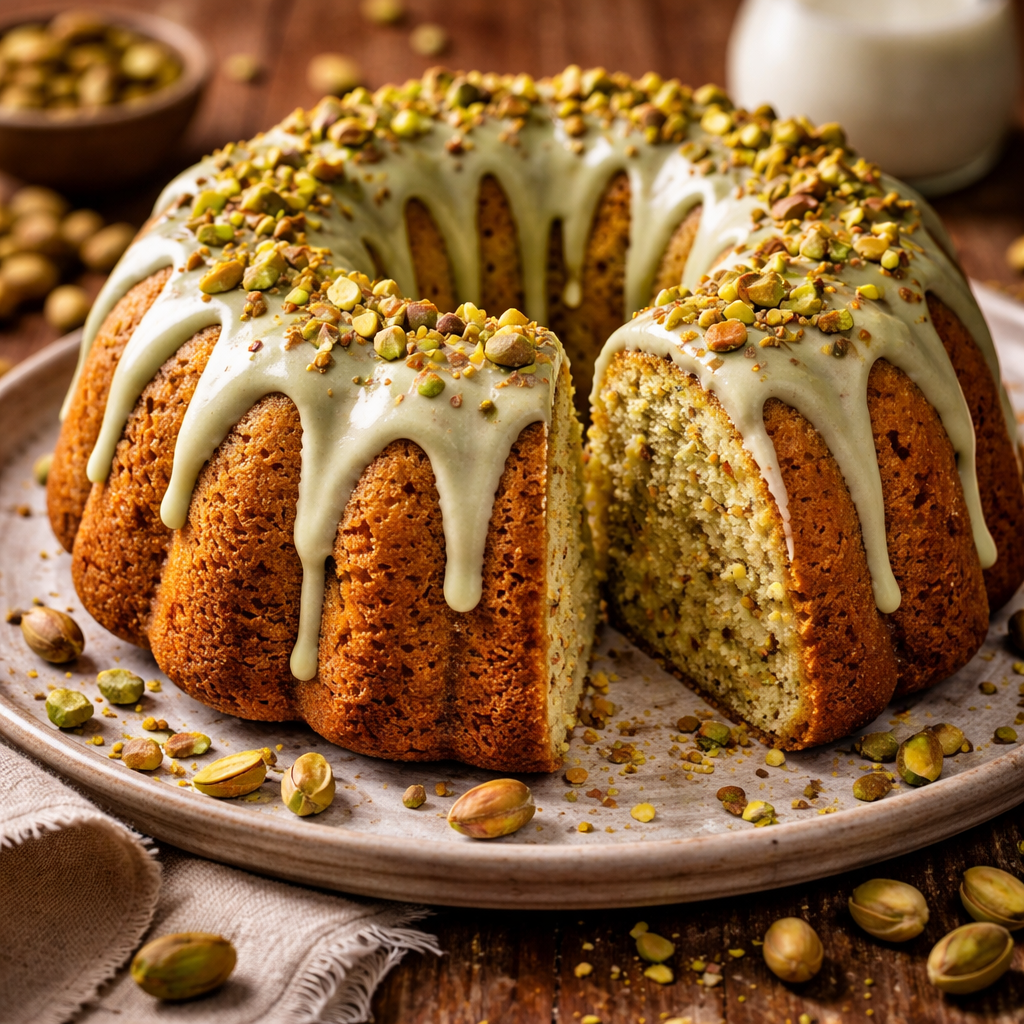
Pour the batter into the prepared pan and smooth the top. Bake for 50 to 60 minutes. The Pistachio Bundt Cake Recipe is done when a wooden skewer inserted into the deepest part comes out clean or with a few dry crumbs.
6. The Critical Release
Cool the pan on a wire rack for exactly 10 minutes. Place the wire rack over the top of the pan and quickly invert. Lift the pan straight up. Allow the cake to cool completely before glazing.
Consistency Issues and Solutions
Even with a detailed Pistachio Bundt Cake Recipe, technical failures can occur if the “physics” of the bake are ignored.
- The Cake Stays in the Pan: This is usually caused by sugar caramelizing against the metal. If the cake sticks, place the pan over a hot, damp towel for 3 minutes to create steam, then try the inversion again.
- The Cake is Dry: Over-baking is the primary culprit. If the internal temperature exceeds $98^{\circ}C$ ($210^{\circ}F$), the moisture has evaporated. Use a thermometer to pull the cake at $96^{\circ}C$ ($205^{\circ}F$).
- A “Tunnel” in the Crumb: This is caused by over-mixing after the flour is added. Once the flour hits the wet ingredients, mix only until the white streaks disappear to prevent excess gluten development.
- The Bottom is Soggy: If the cake is left in the pan for longer than 15 minutes, steam condenses and is reabsorbed by the cake. Stick strictly to the 10-minute release window.
Frequently Asked Questions (FAQ)
Can I use pistachio paste instead of ground nuts?
You can, but it will change the hydration of the Pistachio Bundt Cake Recipe. If using paste, reduce the butter by 2 tablespoons to compensate for the added fats and oils in the commercial paste.
Why is my cake not green?
Natural pistachios provide a muted, earthy green or brownish hue. If you desire a vibrant green color, you must add a drop of gel food coloring. Most restaurant-style cakes use a combination of almond extract and coloring to achieve that specific “pistachio” aesthetic.
How should I store the cake?
Store the cake under a glass dome or in an airtight container at room temperature for up to 3 days. Because of the nut oils and buttermilk, the Pistachio Bundt Cake Recipe often tastes better on the second day as the flavors settle.
Can I freeze this cake?
Yes. Wrap the unglazed, cooled cake tightly in plastic wrap and then foil. It will maintain its quality for up to 3 months. Thaw at room temperature while still wrapped to prevent condensation from forming on the surface.
Is buttermilk necessary?
Buttermilk provides acidity, which reacts with the baking powder for a better lift and tenderizes the gluten. If you do not have buttermilk, you can make a substitute by adding 1 tablespoon of lemon juice to 1 cup of whole milk and letting it sit for 5 minutes.
The Ultimate Snickerdoodle Cake Recipe: Soft, Spiced Perfection
The Ultimate Dubai Chocolate Cake Recipe
Easy Italian Rum Cake Recipe – Perfect for Any Occasion
Easy Cherry Chip Cake Recipe for Beginners
Easy Butter Pecan Cake Recipe – Sweet & Nutty Perfection
Easy Mandarin Orange Cake Recipe for a Perfect Citrus Dessert